By Yvonne Chapman
RE, Central South Presbytery
In coming months, EPC Presbyteries will vote on a proposed amendment to the constitution (BoG 9-3) regarding standards for ordination. Whether it is defeated or not, the amendment will do nothing to quell the controversy currently raging in the denomination.
The proposed amendment says nothing about the ordination of SSA (same-sex attracted) candidates, which is the main issue causing conflict. Even if the amendment is defeated, the 46th General Assembly also approved a revised Pastoral Letter on Human Sexuality that leaves open the door to ordination of celibate homosexuals.
Although the Pastoral Letter lacks constitutional authority, it is intended as guidance for Sessions and Presbyteries.1 Specifically, the Pastoral Letter states:
“Courts may consider for ordination candidates whose ongoing experience of SSA is a corrupted sin nature unindulged, repented of, and mortified; a temptation not entered into, but rather fled; a weakness not embraced, but rather mourned as they rest upon the grace and strength of the Lord.”
In other words, candidates who are still struggling with homosexual desire (present tense) may be considered for ordination as long as they are repentant and not engaging in homosexual behavior. The Pastoral Letter offers a green light for ordaining celibate homosexuals, as long as they are resisting their sinful desires. In short, the language of the Pastoral Letter is permissive, not prohibitive.
The Pastoral Letter requires no vote by Presbyteries and is now an official document of the EPC. The vote on the proposed constitutional amendment will do nothing to change that, even if it is defeated. While not a constitutional document itself, the Pastoral Letter will surely influence the interpretation of any constitutional provisions regarding church officers.
In a press release issued immediately after the 46th General Assembly, the claim was made that the EPC had “strengthened” its ordination and sexual standards. And yet, the fact is that the General Assembly voted down an alternative ascending overture2 that would have prohibited the ordination of celibate homosexuals. The alternate overture would have required that Ruling and Teaching Elders, “… conform in heart, mind, and conduct to God’s design for human sexuality,” and would disqualify “those who profess, persist in, or identify with unnatural desires or affections, contrary to God’s created order and condemned by Scripture as against nature.”
Clearly, the General Assembly rejected a proposed amendment that prohibited the ordination of celibate homosexuals in favor of language that is weak and ambiguous. In light of this vote, to claim that the EPC “strengthened” its ordination and sexual standards is disingenuous, at best.
Gay Ordination Issue Still Unresolved
Supporters of the BoG 9-3 amendment claim it is patterned after a similar provision approved by the Presbyterian Church in America (PCA) and is therefore a sufficient standard for ordination. However, the truth is that the PCA amendment has not resolved the controversy over gay ordination that raged for six years surrounding TE Greg Johnson, pastor of Memorial Presbyterian Church in St. Louis, Mo.
Johnson, who identifies as a celibate homosexual, eventually left the PCA following a series of disciplinary complaints filed against him. However, the controversy resurfaced again in April 2025 after the Missouri Presbytery of the PCA approved the ordination of another same-sex attracted man, prompting a complaint that is now pending before the Standing Judicial Commission of the PCA.
“The controversy over ordaining men who are tempted to Leviticus 18:22-breaking is far from over,” said PCA member Tom Hervey, writing in The Aquila Report. “And if you are in the Evangelical Presbyterian Church and thought that the PCA successfully resisted these things which have so much troubled your own denomination, and that is therefore the place to flee — well, now is your chance to be relieved of that mistaken notion. The PCA has already done what your denomination is about to do.”
If the PCA amendment did not resolve the SSA controversy in that denomination, it is unlikely that the proposed amendment to G.9-3 will resolve our problems in the EPC. Instead of setting a clear standard, it is vague and permissive with enough wiggle room to allow for the ordination of celibate homosexuals.
Amendment Adds Nothing of Substance
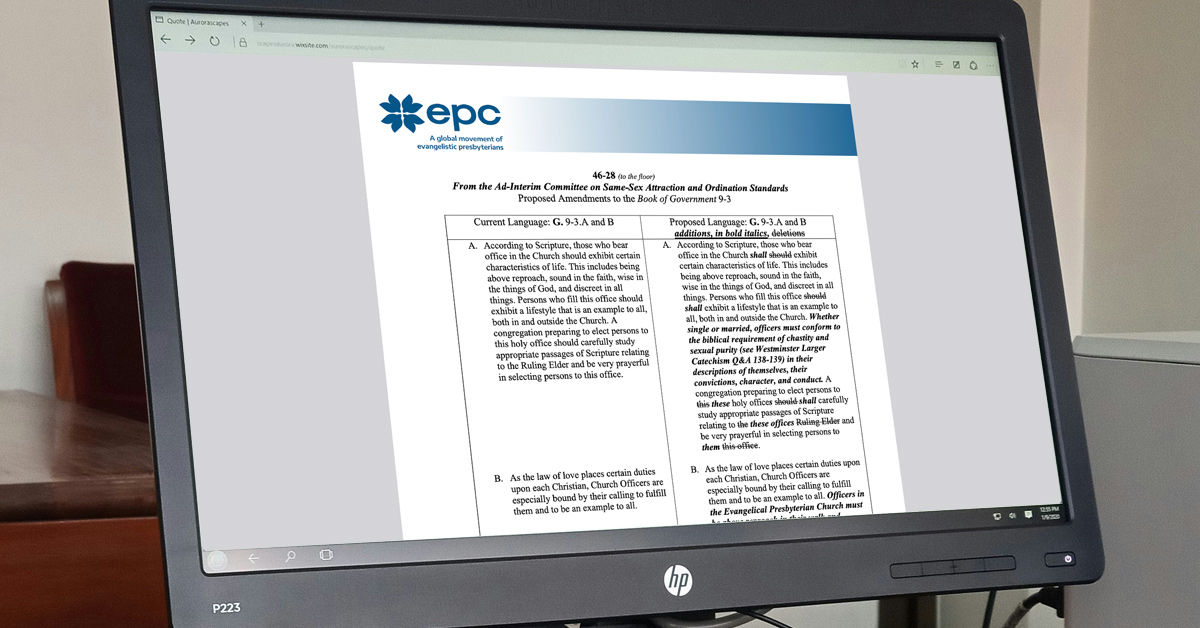
Under the current G.9-3A, a church officer should be “above reproach, sound in the faith, wise in the things of God, and discreet in all things. Persons who fill this office should exhibit a lifestyle that is an example to all, both in and outside the Church.” The amendment to 9-3.A would add the following language:
Whether single or married, officers must conform to the biblical requirement of chastity and sexual purity (see Westminster Larger Catechism Q&A 138-139) in their descriptions of themselves, their convictions, character, and conduct.
While sounding like an improvement to the conduct for church officers, this provision adds nothing but merely reiterates what is already contained in the Westminster Confession.
The amended provision in G.9-3.B states:
Officers in the Evangelical Presbyterian Church must be above reproach in their walk and Christlike in their character. While office bearers will see spiritual perfection only in glory, they will continue in this life to confess and to mortify remaining sins in light of God’s work of progressive sanctification. Therefore, to be qualified for office, they must affirm the sinfulness of fallen desires, the reality and hope of progressive sanctification, and be committed to the pursuit of Spirit empowered victory over their sinful temptations, inclinations, and actions.
Currently, G.9-9 requires Ruling Elders to be “mature believers, led by the Holy Spirit, who exhibit a manner of life that conforms to the Biblical description of an officer in Christ’s Church,” citing in footnote 58, Numbers 11:16-17; Exodus 18:21; Romans 8:1-17; Romans 12; 1 Timothy 3:1-13; Titus 1:5-9; G.9-3; and G.9-4.
Among other qualifications, all officers in the church “should be mature in the faith, should be people of wisdom and discretion, and should have adequate training to equip them for their calling. Elders, especially those called to the office of Teaching Elder, should have an aptitude for teaching.” G.9-4.
G.9-7 provides “According to Scripture, those who bear the office of Teaching Elder should be mature believers, led by the Holy Spirit, who exhibit a manner of life that conforms to the Biblical description of an officer in Christ’s Church.”
The candidate for Teaching Elder is subjected to public examination before ordination, required to narrate his or her experience of conversion to Christianity and life as a Christian, in addition to a theological examination. (See Chapters 11 and 12 of the Book of Government). Properly executed, these examinations explore the candidate’s mortification of sin and experience of sanctification. Again, the amendments to G.9-3 add nothing to the standards that already exist.
What the G.9-3 amendments fail to address is the ordination of homosexuals, celibate or not, who have an ongoing experience of homosexual attraction. On this issue, the amendment is strangely silent. In short, the proposed amendment adds nothing of substance and does nothing to remedy the one issue that is dividing the EPC. In the words of the Prophet Jeremiah:
“They dress the wound of my people as though it were not serious. Peace, peace, they say, when there is no peace. Are they ashamed of their loathsome conduct? No, they have no shame at all; they do not even know how to blush.” (Jeremiah 6:14-15).
Vote by Presbyteries Makes No Difference
In his February 2026 Plumb Line article, “New Ad Interim Committee BoG Amendment Insufficient,” RTS Professor Emeritus Don Fortson explained how same-sex attraction is sinful, unnatural, and disqualifying for those seeking ordination to church office. Fortson based his argument on the Bible and the Westminster Larger Catechism:
The AIC amendment states that church officers “must affirm the sinfulness of fallen desires.” This language, while Biblical, is insufficient to meet the question at hand … This statement allows room for a SSA person to acknowledge same-sex desires are rooted in the Fall, while simultaneously denying SSA itself is sin … Evil desires within the human heart can’t be blamed on God, nor are they morally neutral. They are sin. Same-sex temptations, desires, lusts, and acts are all sin according to Scripture. Experiencing ongoing SSA is a sign of sin and a lack of sanctification. The Westminster Larger Catechism Q. 139 states that “sodomy and all unnatural desires” are forbidden by the seventh commandment. The Biblical proof texts for “all unnatural desires” are Romans 1:24, 1:26-27, and Leviticus 20:15-16. If one has continuing SSA experience, he is not mature in sanctification but needs repentance, pastoral care, and discipleship. It would be irresponsible to place such a person in church office — it would not be safe for his soul nor the souls of those to whom he would minister. (Emphasis in original).
Voting either for or against these amendments will not bring about reform of Biblical standards for ordination within the EPC. Even if defeated, it will not change the damage done by the Pastoral Letter. Nevertheless, it is important that elders vote down the proposed constitutional amendment in their Presbyteries. Defeating this amendment would at least send a message of disapproval with this sorry process that is causing many churches to seek dismissal from the EPC.
The Process for a Constitutional Amendment
As elders prepare to vote on the G.9-3 amendment in their Presbyteries, we offer the following guidance to explain the voting process:
- Following approval by the 46th General Assembly, the recommended change is sent to the Presbyteries (as a Descending Overture).
- An amendment requires approval by three-fourths of the Presbyteries. Since the EPC currently has 16 Presbyteries, 12 must vote to approve the amendment. A vote to disapprove by 5 presbyteries3 or the failure of 12 presbyteries to vote to approve will cause its failure.
- If 12 Presbyteries vote to approve the Descending Overture, the measure is sent to the subsequent General Assembly for ratification.
- If an insufficient number of Presbyteries have voted on the measure by the convening of the subsequent GA, they shall be urged to vote. If, by the second subsequent GA, an insufficient number of Presbyteries voted to approve the amendment, it shall fail.
For a full exposition of the procedure to amend the constitution, see G.23-1 (page 60).
____________________
1 See definition of the term “Pastoral Letter” adopted by the 17th General Assembly, Minutes 17-30.
2 Not everyone is aware that the ascending overtures from the five presbyteries which sought to disqualify from ordination homosexuals — even those who claim celibacy — were proposed before the final AIC recommendations were released and well before the AIC proposed amendments to G.9-3. For further analysis of these overtures, see Five Overtures Ruled Unconstitutional: An Appraisal of the PJC Report on Overtures to Amend G.9-3A.
3 Some express the hope that a strategy for Ruling Elders who opposed the AIC recommendations can constitute a majority at presbytery to vote against the amendment under the provision in G.19-2A4b for Disparity Corrections. The method for correcting “a disproportionate ratio of Teaching Elders to Ruling Elders” is “the Presbytery shall move to correct the ratio by assigning to member churches on a yearly alphabetical rotational basis the right to elect additional Ruling Elder Commissioners to the Presbytery.”


Leave a Comment