By Don Fortson
TE, Presbytery of the Central Carolinas
At a meeting of Presbytery of the West, a member of the Ad Interim Committee (AIC) on same sex attraction and ordination offered a critique of the Presbytery of the Pacific Northwest (PNW) overture. Some refer to this overture as the “Red Line Overture” referencing the Red Line Statement signed by over three hundred REs and TEs who oppose the ordination of same-sex attracted persons (celibate homosexuals) to church office. The PNW overture was adopted by additional presbyteries and supported by hundreds of TEs and REs throughout the EPC. I am among the supporters of the PNW overture because it is biblically and confessionally faithful.
Presbytery of the Pacific Northwest Overture (Adopted by four Presbyteries):
“Therefore, persons eligible for church office shall conform in heart, mind, and conduct to God’s design for human sexuality, embracing with gratitude the calling of either chastity in singleness or fidelity within marriage between one man and one woman. Those who profess, persist in, or identify with (unnatural desires or affections contrary to God’s created order and condemned by Scripture as against nature) are disqualified from holding office in Christ’s church.
Footnote: See Romans 1:26,27 on desires contrary to God’s created order, Genesis 1,2 on the creation of male and female. Westminster Larger Catechism question 139 on the moral duties of Christians and the proper ordering of affections.
We are grateful to the AIC member for publicly commenting on the PNW Overture, because it brings clarity to the confusion many have had trying to understand the AIC report. The confusion is rooted in the AIC’s use of Biblical and confessional language, then contradicting itself by supporting celibate homosexual ordination in the EPC. Now, with the final AIC report in hand we know clearly that the AIC is indeed backing celibate homosexual ordination, and with public comments by AIC members we can finally discern the AIC’s rationale behind their unbiblical position.
The AIC presenter at the Presbytery of the West remarked that the PNW overture “oversteps the Biblical and confessional bounds.” In actuality, the opposite is true — the PNW overture is faithful to Scripture and the Westminster Standards. It is the AIC report’s support for celibate homosexual ordination that doesn’t align with what Scripture teaches about homosexuality (same sex attraction) nor what the Larger Catechism asserts about homosexuality being a more heinous unnatural sin.
Scripture and the Larger Catechism on Homosexuality
What Scripture teaches is always the beginning point in theological controversy among Presbyterians who take the Bible seriously. WCF 1.10 asserts:
“The supreme judge by which all controversies of religion are to be determined, and all decrees of councils, opinions of ancient writers, doctrines of men, and private spirits, are to be examined, and in whose sentence we are to rest, can be no other but the Holy Spirit speaking in the Scripture.”1
When it comes to interpreting Scripture the WCF gives us this rule:
“The infallible rule of interpretation of Scripture is the Scripture itself: and therefore, when there is a question about the true and full sense of any Scripture (which is not manifold, but one), it must be searched and known by other places that speak more clearly.” (WCF 1.9).
The principles above from WCF 1.9,10 are important for looking at what Scripture teaches about homosexuality. There are many passages in Scripture which speak to the perversion of homosexuality and God’s judgment upon it (Genesis 19; Judges 19; Leviticus 18, 20; Romans 1; 1 Corinthians 6; 1 Timothy 1). The Biblical text that speaks most clearly of homosexuality is Romans 1:26,27:
“For this reason God gave them up to dishonorable passions. For their women exchanged natural relations for those contrary to nature; and the men likewise gave up natural relations with women and were consumed with passion for one another, men committing shameless acts with men and receiving in themselves the due penalty of their error.” (ESV)
Same-sex lusts/sexual acts are rebellion against the Creator, specifically described as a man or woman exchanging natural relations for unnatural relations. St. Paul speaks of this as “dishonorable passion” that is “contrary to nature.” Homosexuality is singled out as unnatural in Romans 1. No other sins in the long vice list in Romans chapter 1 are referred to as unnatural.
The Larger Catechism asserts that “sodomy and all unnatural lusts” are sins forbidden in the seventh commandment (L.C. Q. 139). The Biblical proof texts for “sodomy and all unnatural lusts” are Romans 1:24,26,27 and Leviticus 20:15,16. The pairing of these proof texts demonstrates that in the minds of the Westminster Divines “unnatural lusts” refers to both homosexual lusts and bestiality. This is clearly the case, since the language of “contrary to nature” (i.e., “unnatural”) comes directly from Romans 1:26.
There is a second place where the Larger Catechism addresses homosexuality as against nature.
L.C.Q. 150: “Are all transgressions of the law of God equally heinous in themselves, and in the sight of God?”
A. “All transgressions of the law of God are not equally heinous; but some sins in themselves, and by reason of several aggravations, are more heinous in the sight of God than others.”
The following question (L.Q.151) addresses the aggravations which make some sins more heinous in the sight of God. One aggravation is “from the nature and quality of the offence” and under this category the catechism has a list of offenses including those “against the light of nature” (L.C.Q.151.3). The lone proof text for “against the light of nature” is Romans 1:26,27.
Twice in the Larger Catechism (L.C.Q. 139, 151) the Westminster Divines cite Romans 1:26, 27 using the unique unnatural/against nature category for homosexuality. The language of “unnatural lusts” (L.C.Q. 139) and “against the light of nature” (L.C.Q.151) comes directly from the Romans 1 passage’s use of the phrase “contrary to nature.” This is the habit of the Westminster Divines who use Biblical phrases repeatedly in the confession and catechisms.
AIC Rejects the Teaching of the Larger Catechism
It appears that the AIC disagrees with what the Larger Catechism says about homosexuality being “unnatural lusts” and “against the light of nature.” In the Presbytery of the West AIC presentation, this statement was made against the PNW overture:
“We feel like using the terms unnatural desires or affections is constitutionally novel. The term unnatural is absent from the Book of Order and its single confessional reference is in Westminster Larger Catechism 138. And in 139 where it talks about commandment seven where it says, “adultery, fornication, rape, incest, sodomy and all unnatural desires.” So for us this word created a couple of problems. First, it introduces a category of sin into the Constitution that is not defined here or elsewhere in our constitutional work. And second, unnatural lust in our catechism (WLC 139) is something that is in addition to sodomy. If you look at it sodomy is homosexuality. So, the unnatural is something in addition to that. It’s not descriptive of sodomy itself. Or it serves as a comprehensive description of all the sins that violate the seventh commandment. So either it’s an addition to, or unnatural means everything that is listed which includes heterosexual sins as well.”
These comments are telling because they expose the AIC’s unwillingness to accept the Church’s historic understanding of Romans 1:26,27 and the L.C.’s use of this text. Romans 1:26,27 clearly equates homosexuality with “unnatural desires or affections.” This is the very point St. Paul is making — homosexual passions and acts are contrary to nature, that is, opposing the way God created men and women for each other sexually. The description of homosexuality as against nature is so transparent in Romans 1:26, 27 that L.C. Q. 139 and 151 cite the text as a proof for the assertions that homosexuality is an “unnatural lust” and “against the light of nature.” If one wants certainty on understanding the intent of the words used in the Larger Catechism, look at the Scripture texts the Westminster Divines reference! “Unnatural lust” and “against the light of nature” are defined by what Romans 1:26,27 teaches. The AIC’s assertions that
- using the terms “unnatural desires or affections” is constitutionally novel,
- doing so introduces an undefined category of sin, and
- “unnatural lust” in the L.C.Q. 139 is not referring to sodomy (homosexuality)
are undisputably false. The novelty is what is being asserted by the AIC!
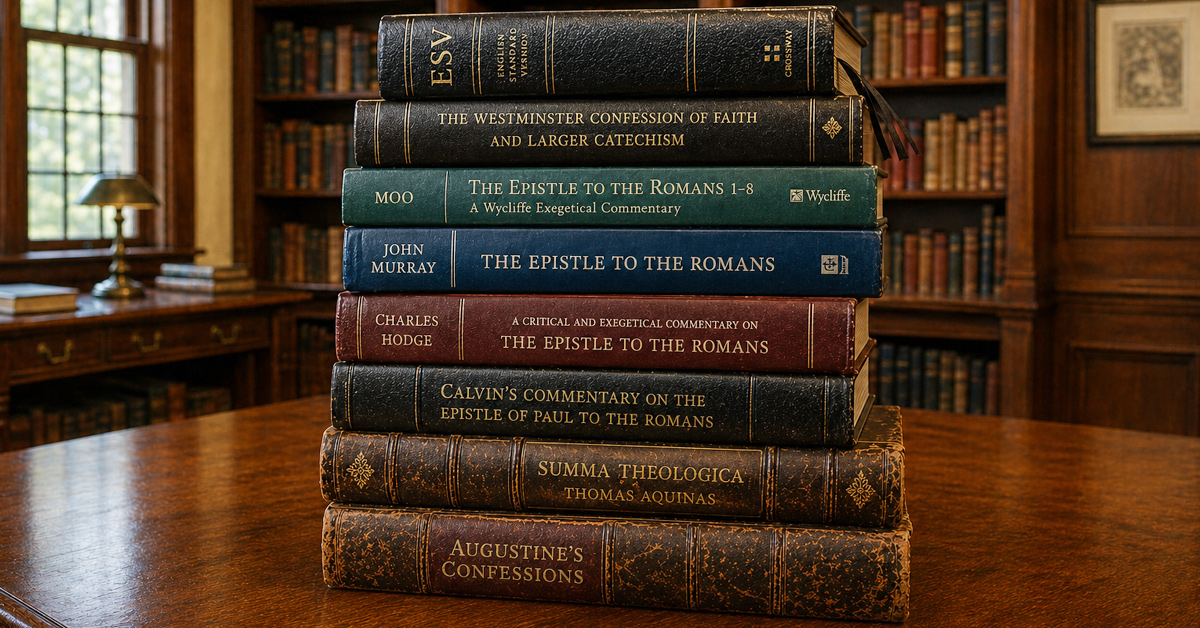
The peculiarity of the AIC’s dismissal of homosexual passions as uniquely “unnatural desires” is glaring when one compares it with the views of the Church Fathers, Reformers, and Reformed theologians who have commented on Romans 1:26,27 over the centuries. The term “unnatural” always referred uniquely to homosexuality in historical writers because this is explicitly what Romans 1:26,27 declares in Paul’s argument. Below is a sampling of the orthodox understanding of “unnatural” in Romans 1 — note the comments about same sex desires/lusts/passions and same sex acts.
Augustine, Bishop of Hippo in North Africa
Confessions, 397
“Therefore those offenses which be contrary to nature are everywhere and at all times to be held in detestation and to be punished; such were those of the Sodomites, which should all nations commit, they should be held guilty of the same crime by the divine law, which hath not so made men that they should in that way abuse one another.”
Thomas Aquinas, Medieval Theologian
Summa Theologica, 1274
“[Homosexuality] is contrary to the natural order of the venereal act as becoming to the human race: and this is called the unnatural vice. This may happen … by copulation with an undue sex, male with male, or female with female, as the Apostle states (Romans 1:27): and this is called the vice of sodomy …. Therefore, since by the unnatural vices man transgresses that which has been determined by nature with regard to the use of venereal actions, it follows that in this matter this sin is the gravest of all …. in sins contrary to nature, whereby the very order of nature is violated, an injury is done to God, the Author of nature ….”
John Calvin, Geneva Reformer
Commentary on the Epistle of Paul the Apostle to the Romans, 1540
“He brings as the first example, the dreadful crime of unnatural lust; and it hence appears that they not only abandoned themselves to beastly lusts, but became degraded beyond the beast, since they reversed the whole order of nature …. Paul here records those abominations which had been common in all ages, and were at that time especially prevalent everywhere; for it is marvellous how common then was that filthiness which even brute beasts abhor; and some of these vices were even popular …. He calls those disgraceful passions, which are shameful even in the estimation of men, and redound to the dishonouring of God.
Charles Hodge, Professor of Biblical Literature and Didactic Theology, Princeton Theological Seminary
Romans, 1835
“God gave them up to corrupt feelings. Shameful lusts means passions which are degrading and when indulged in cover men with ignominy … these sins are especially degrading; and that they were most notorius, prevalent, and openly acknowledged of all the crimes of the heathen world.” p.40.
John Murray, Professor of Systematic Theology, Westminster Theological Seminary
The Epistle to the Romans, 2 vols, 1959
“… the stress falls upon the unnatural [italics his] character of the vice and in that, as also in verse 27, consists the peculiar gravity of the abomination. The implication is that however grievous is fornication or adultery the desecration involved in homosexuality is on a lower plane of degeneracy; it is unnatural and therefore evinces a perversion more basic.” p.47
Douglas Moo, Evangelical Calvinist Bible Scholar, Trinity Evangelical Divinity School and Wheaton College
Wycliffe Exegetical Commentary, Romans 1-8, 1991 pp.109,110
“In keeping with the biblical and Jewish worldview, the heterosexual desires observed normally in nature are traced to God’s creative intent. Sexual sins that are ‘against nature’ are also then against God … Paul associates homosexuality with the perversion of true knowledge of God already depicted in vv. 23 and 25 … it is clear that Paul depicts homosexuality as a violation of God’s created order, another indication of the departure from true knowledge and worship of God.”
Frank Thielman, Presbyterian Chair of Divinity, Beeson Divinity School
Exegetical Commentary on the Book of Romans, 2018
“Paul understood homoerotic sexual activity to be ‘dishonorable’ (1;24; 1:26) and obscenity. The context indicates that the dishonor lay in the inconsistency of this action with what was ‘natural’ (1:26,27). ‘Natural’ means neither ‘without passion’ not ‘culturally normal’ but ‘what is obvious from the operation of the physical world.’ (cf. 2 Peter 2:12). Paul thought that the eternal power and divinity of the Creator were obvious from the physical world and led clearly to the conclusion that people should glorify and thank the Creator (1:20-21). In the same way, Paul probably considered the ‘natural’ character of heterosexual activity to be obvious from the physical anatomy of male and female and from the role of heterosexual intercourse in the production of children.”
Kevin DeYoung, Sr. Pastor, Christ Covenant Church (Matthews N.C.); Moderator, Presbyterian Church in America; Professor of Systematic Theology, Reformed Theological Seminary
Sermon: “Contrary to Nature” (23:25) Romans 1:24-27, March 22, 2026
“What is the sin Paul is condemning in verses 26 and 27? The sin he is condemning is being inflamed with passion for someone of the same sex and engaging in sexual activity with someone of the same sex. Both the passion and the action he considers to be an affront to God’s created order … He condemns all homosexual desires and every kind of homosexual activity …. He gives three words. The sin is dishonorable. It is unnatural. And it is shameless .… He has hard words to say about this sin. He wants to depict it with dark, ugly colors, because he believes that it is an ugly offense. That’s the reality of these verses …. So, the key term here – this is the moral logic — is that homosexuality is contrary to nature, para physin in the Greek …. And here’s the argument Paul’s making. As much as we may not like to see it, it’s the argument he’s making.”
Conclusion
It is tragic to observe the AIC using the tactics of gay Christian writers who have attempted to explain away Romans 1:26,27 since the 1970s. Paul’s assertion that homosexual lust and acts are uniquely “against nature” is manifestly evident in Romans 1:26,27. Those claiming to be evangelicals with a high view of Scripture must not attempt this theological subterfuge. It is senseless to reject the historic teaching of the Church on homosexuality in an attempt to justify celibate homosexual ordination. This has been the strategy of mainline churches. We cannot accept this Biblical misrepresentation. The AIC report is based on suppressing the clear Scriptural and constitutional (L.C.) teaching on homosexuality including homosexual desires. We must vote against the AIC report.
____________________
1 All citations from the Westminster Larger Catechism come from the 1788 edition which was adopted by American Presbyterians.


Leave a Reply to Mike FankhauserCancel reply