By the Editorial Board, Presbyterian Plumb Line
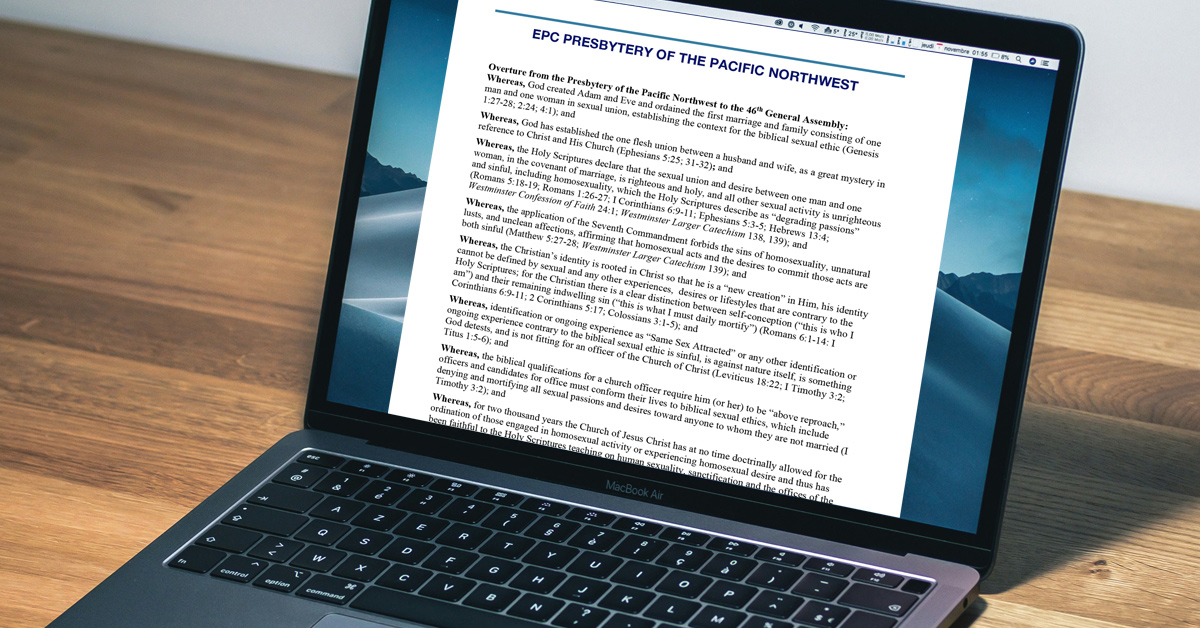
Five Presbyteries have sent overtures to General Assembly that would amend our constitution to forbid the ordination of homosexual clergy, whether they are celibate or not. You may be wondering, why is this overture needed? However, even if the AIC report is defeated at General Assembly, the issue is still unresolved. Basically, we would be back to square one where we were two years ago when all the controversy started.
For this reason, we need a clear constitutional standard that applies to all the churches in the EPC. In the absence of such a standard, we will be in the position of each presbytery setting its own standard — what has been called “local option.” Of course, this will only set us up for more conflict and chaos, as presbyteries clash over different ordination standards. What we need is clarity, not confusion. For this reason, we ask you to support the Pacific Northwest Presbytery Overture.
We believe the PNW overture will close the door for ordination of those who are still struggling with homosexual desire. While these individuals deserve our love and support, they should not be ordained to church leadership. Below is the PNW overture’s proposal for amending BoG 9-3.A which is followed by answers to questions about the proposed amendment.
Pacific Northwest Presbytery’s Proposed Amendment to BoG 9-3.A:
“Therefore, persons eligible for church office shall conform in heart, mind, and conduct to God’s design for human sexuality, embracing with gratitude the calling of either chastity in singleness or fidelity within marriage between one man and one woman. Those who profess, persist in, or identify with unnatural desires or affections, contrary to God’s created order and condemned by Scripture as against nature, are disqualified from holding office in Christ’s Church.
See Romans 1:26–27 on desires contrary to God’s created order; Genesis 1–2 on the creation of male and female; Westminster Larger Catechism Q.139 on the moral duties of Christians and the proper ordering of affection.”
Answers to Questions about the PNW Overture
1. Why does the amendment begin with conforming to God’s design for marriage and singleness?
The pastoral epistles connect the government of the church with the government of the household (1 Timothy 3:1–7; Titus 1:5–9). Scripture teaches that the church is “the household of God,” and therefore a candidate’s conformity to God’s created order in the most fundamental human relationships bears directly upon his fitness for ordained office.
The amendment therefore begins positively by affirming God’s design for human sexuality: chastity in singleness and fidelity within marriage between one man and one woman.
In relation to homosexual desires, the concern is not merely outward conduct, but inward affections and inclinations. A person who continues to experience persistent homosexual desire is experiencing disorder in relation to the created order of the household. While such a struggle may be sincerely resisted, the church must still ask whether a person whose desires remain disordered in this foundational area is qualified to bring order to the family of God.
2. What does “profess unnatural desires or affections” mean?
To “profess” unnatural desires or affections means to publicly acknowledge or openly describe oneself as experiencing such desires.
This language addresses situations in which a candidate openly states that he experiences ongoing same-sex attraction or describes himself in terms connected to homosexual desire, even if he also affirms celibacy or repentance.
3. What does “persist in unnatural desires or affections” mean?
To “persist” means to continue over time despite opposition, repentance, prayer, and efforts toward mortification.
The amendment recognizes that Christians may sincerely repent of sin while still experiencing ongoing temptation and corruption. Nevertheless, persistent unnatural desire remains significant when considering fitness for ordained office.
The issue is not whether one is repentant, but whether the continued presence of such desires bears upon the qualifications required for shepherding Christ’s church. The overture argues that it does.
4. What does “identify with unnatural desires or affections” mean?
This refers to making disordered sexual desire part of one’s personal identity or self-conception.
For example, a person may reject homosexual behavior while still describing himself as a “gay Christian” or understanding homosexuality to be a defining aspect of who he is. The overture rejects such identity language because Christians are to understand themselves fundamentally in union with Christ rather than in terms of sinful desires.
5. What are “unnatural desires or affections”?
This language is drawn from Scripture itself, especially Romans 1:24–27 and Jude 7, as well as the teaching of the Westminster Larger Catechism 139.
Scripture describes homosexual practice and desire as “against nature” because they violate God’s created order for human sexuality. Romans 1 particularly emphasizes “dishonorable passions” and desires “contrary to nature.”
The overture therefore uses biblical and confessional language rather than modern psychological categories such as “sexual orientation” or even “same-sex attraction.” The goal is to speak as closely as possible in the language of Scripture.
6. Is not all sin “unnatural” in some sense?
In one sense, all sin is contrary to God’s will and therefore contrary to humanity’s created purpose. However, Scripture itself distinguishes sins that are specifically “against nature” from other forms of sin.
Romans 1 treats homosexual desire and conduct as especially significant because they involve a rejection of the created order revealed in nature itself. The unnaturalness of the sin described in Romans 1:24-27 does not categorize all sins, but rather those that uniquely transgress the natural order established by God in creation.
The overture therefore does not claim that homosexuality is the only sin, nor that Christians struggling against it are beyond God’s grace. Rather, it recognizes the particular Biblical category Scripture itself assigns to unnatural sexual sin.
7. Does this overture deny progressive sanctification or the reality of indwelling sin?
No.
The overture fully affirms the biblical doctrine of progressive sanctification and acknowledges that believers continue to battle indwelling sin throughout this life. Christians are not perfected in holiness before glorification.
However, acknowledging indwelling sin does not mean every form of remaining corruption is equally compatible with ordained office. Scripture recognizes that certain patterns of sin, weakness, or disorder may bear directly upon a candidate’s qualifications for leadership in the church.
The question is therefore not whether one still battles sin, but whether persistent unnatural sexual desire is compatible with the moral and spiritual qualifications required for ordained office. The overture argues that it is not.
8. Does this overture make ordination impossible for everyone because everyone is tempted in some manner?
No.
The overture does not teach sinless perfection, nor does it require freedom from all types of temptation. Rather, it addresses a particular category of disordered desire that Scripture identifies as contrary to nature.
Most Christians do not and have not experienced ongoing homosexual desire. While all believers battle sin in various ways, Scripture and the church have historically recognized that not all forms of temptation bear equally upon qualification for ordained ministry. This overture argues that the presence of unnatural desire, as defined above, is disqualifying.
9. Does this overture mean that someone who experienced unnatural desires in the past can never be ordained?
No.
The gospel of Jesus Christ brings true cleansing and transformation. Christians may be delivered from all forms of sinful desire and corruption through the sanctifying work of the Holy Spirit.
The overture is concerned with present qualification for office, not with permanently excluding all who have struggled in the past. A candidate who formerly experienced unnatural desires but by God’s grace no longer does so would not necessarily be disqualified on that basis alone.
10. Is this overture singling out one category of sinners?
The overture addresses a specific issue because the denomination is currently debating whether candidates who openly acknowledge ongoing same-sex attraction may be ordained. Addressing a particular controversy does not imply that other sins are unimportant.
| Current Book of Government 9-3A. According to Scripture, those who bear office in the Church should exhibit certain characteristics of life. This includes being above reproach, sound in the faith, wise in the things of God, and discreet in all things. Persons who fill this office should exhibit a lifestyle that is an example to all, both in and outside the Church. A congregation preparing to elect persons to this holy office should carefully study appropriate passages of Scripture relating to the Ruling Elder and be very prayerful in selecting persons to this office. | Proposed Book of Government 9-3A. “According to Scripture, those who bear office in the church shall exhibit certain characteristics of life. This includes being above reproach, sound in the faith, wise in the things of God, and discreet in all things. Persons who fill these offices shall exhibit a lifestyle that is an example to all, both in and outside the Church. Therefore, persons eligible for church office shall conform in heart, mind, and conduct to God’s design for human sexuality, embracing with gratitude the calling of either chastity in singleness or fidelity within marriage between one man and one woman. Those who profess, persist in, or identify with unnatural desires or affections, contrary to God’s created order and condemned by Scripture as against nature, are disqualified from holding office in Christ’s Church.1 A presbytery or congregation preparing to elect persons to these holy offices shall carefully study appropriate passages of Scripture relating to the Teaching Elder, Ruling Elder, and Deacon, and be very prayerful in electing persons to these offices. 1 See Romans 1:26–27 on desires contrary to God’s created order; Genesis 1–2 on the creation of male and female; Westminster Larger Catechism Q.139 on the moral duties of Christians and the proper ordering of affections. |

Leave a Comment